
Prior authorization doesn't typically fail because a medication isn't covered. More often, delays happen because the process itself creates friction at multiple points along the way.
Every prescribing decision passes through three forms of confidence: clinical confidence, coverage confidence, and affordability confidence. Prior authorization sits at the coverage stage. When that process becomes difficult to navigate, it can delay treatment, create additional work for clinic staff, and make it harder for patients to access the medications their prescriber selected.
According to the AMA's 2025 survey, physicians complete an average of 40 prior authorizations each week, spending roughly 13 hours on related administrative tasks.
.png?width=685&height=529&name=blog%20-%20prior%20auth%20breakdown%20-%20cost%20stats%20(1).png)
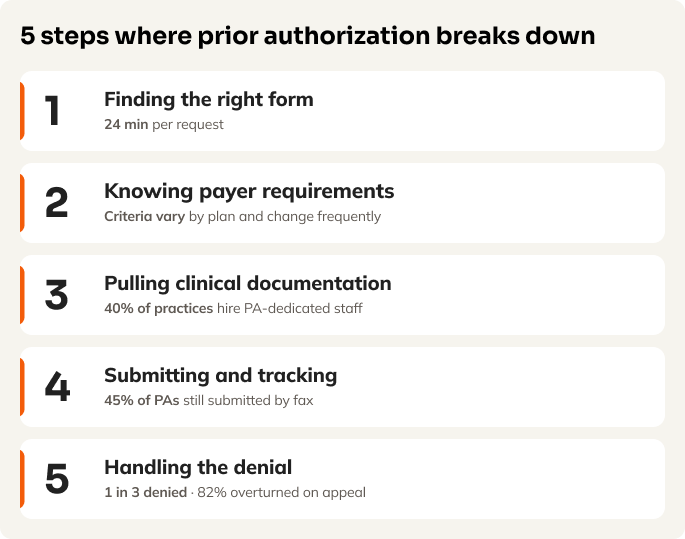
Here are five places where prior authorization workflows commonly create delays.
1. Finding the right form
The process often begins with locating the correct form for a specific medication, payer, and plan.
There is no universal prior authorization form, and payer websites vary widely in how forms are organized and maintained. In some cases, staff may need to search multiple locations or log into payer portals before finding the appropriate documentation.
Manual prior authorization requests take an average of 24 minutes per case. A significant portion of that time can be spent identifying the correct form before any clinical information is submitted.
2. Knowing what the payer actually requires
Even after finding the correct form, determining exactly what information is required can be challenging.
Some plans require step therapy. Others may require documentation of previous treatments, clinical notes, or supporting lab results. Requirements can differ not only between payers, but also between plans offered by the same insurer.
Because requirements change frequently, clinic staff often spend additional time confirming what information is needed before a request can be submitted successfully.
3. Pulling the clinical documentation
Prior authorization requests frequently require diagnosis codes, medication history, treatment duration, laboratory results, and other patient information.
While this information often exists within the EHR, collecting and organizing it to match payer requirements remains a manual process for many practices.
Staff regularly move between the EHR, payer forms, and supporting documentation to complete requests. According to the AMA, two in five physicians now employ staff dedicated primarily to prior authorization activities.
4. Submitting and tracking the request
Submission methods vary significantly across payers. While electronic submission options continue to expand, many requests are still sent by fax.
Once submitted, tracking status can become another administrative task. Without a standardized process across payers, staff may need to monitor multiple systems or contact payer representatives to determine the status of a request.
5. Handling the denial
Many prior authorization denials are tied to administrative issues such as incomplete documentation, missing information, or unmet payer requirements.
When appeals are submitted, a large percentage are ultimately overturned. However, preparing and submitting appeals requires additional time and resources that many practices do not have readily available.
As a result, treatment delays can persist even when a medication may ultimately qualify for coverage.
What this means for the prescribing decision
Prior authorization influences more than administrative efficiency. It affects confidence in the prescribing process itself.
When coverage requirements are difficult to navigate, clinic staff spend more time managing paperwork and less time supporting patients. Delays can make it harder for patients to begin treatment, even after a prescribing clinician has identified the appropriate medication.
Improving prior authorization workflows is not about asking practices to do more. It is about reducing friction at each step so prescribing decisions can move forward with greater clarity, efficiency, and confidence.